
Infinityn and Trendemon Forge Strategic Partnership
Infinityn and Trendemon Forge Strategic Partnership to Drive Growth and Innovation for Customers
Keeping up with what’s happening in GTM can feel overwhelming when you’re juggling a full schedule. That’s why this monthly recap is here. Each month, we pull together the key insights from the latest GTMonday newsletters from GTM Partners and highlight what’s worth noticing.
Now grab a coffee, take a breath, and enjoy January's GTM highlights.
Original newsletter date: Jan 05, 2026
AI has quickly become part of almost every go to market conversation. GTM leaders are under pressure to adopt new tools, automate more workflows, and move faster than ever. Yet many teams are seeing more activity without better results.
This GTM Partners research argues that the problem is rarely the quality of the AI itself. Most GTM AI initiatives fail because they are introduced without clarity on growth stage, strategy, and ownership. AI does not create leverage on its own. It simply accelerates whatever GTM system already exists.
Recent research shows that most AI initiatives never deliver meaningful revenue impact. Not because the technology is weak, but because it is deployed into unclear or misaligned GTM systems. When strategy is fuzzy, AI scales confusion. Teams add tools instead of making decisions. Activity increases, but win rates, deal velocity, and customer experience do not improve. Companies that succeed with AI focus first on alignment, not automation.
The newsletter introduces a diagnostic designed to help GTM teams see whether AI is helping or hurting their growth.
Common warning signs include higher sales activity without higher revenue, growing pipelines with flat or declining win rates, slower decisions despite more dashboards, and reps spending more time managing tools than selling.
The more of these signals a team sees, the more likely AI is amplifying GTM misalignment rather than fixing it.
Teams with only a few warning signs are likely using AI in a way that fits their stage and should stay disciplined. Teams showing many warning signs are often scaling activity without leverage. In these cases, the real issue is not AI, but lack of clarity around GTM stage and strategy.
Adding more tools in this situation usually makes things worse, not better.
Source: A new diagnostic for 2026: Is your GTM AI failing you? (2026) GTMonday by GTM Partners.
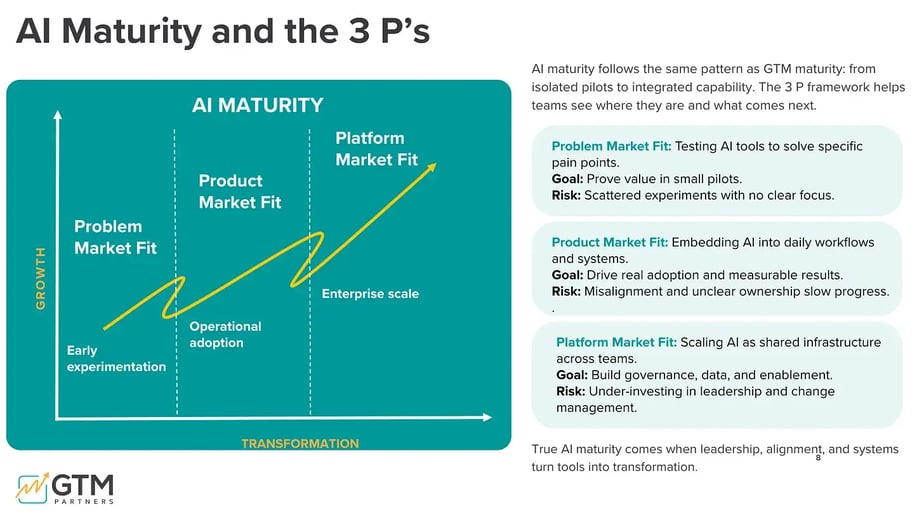
The research connects AI usage to the three stages of growth.
If win rates are low, AI should help you learn faster, not sell faster.
Best AI use cases:
call and interview analysis
objection clustering
ICP discovery and pattern recognition
message testing (quality over volume)
Once win rates are stable and one use case repeats, speed matters more.
Best AI use cases:
speed-to-lead automation
deal inspection and risk alerts
sales assist for consistent messaging
funnel analysis to find drop-off points
At this stage, AI becomes a coordination layer across teams.
Best AI use cases:
churn and expansion prediction
account prioritization across Sales + CS
territory planning and capacity modeling
pricing and packaging analysis
The companies that win with GTM AI in 2026 will not be the ones using the most tools.
They will be the ones with the clearest alignment between growth stage, GTM strategy, and AI execution. AI does not replace clarity. It rewards it.
Original newsletter date: Jan 12, 2026
This week’s GTM Partners newsletter is a reminder that while AI is changing how teams work, the basics of go to market growth have not changed. Markets feel unstable. Buying teams shift. AI tools evolve quickly. Because of this, many teams start to believe that the fundamentals no longer matter. According to the research, that belief is wrong. AI is not changing how growth works. It is exposing where GTM was already broken.
Below are the seven GTM truths that still matter.
Growth problems are often blamed on execution. Teams think they need better reps, more leads, or more tools. In reality, growth is usually limited by GTM strategy. Who you target, why they buy, and how teams work together matter more than any tool. AI can speed up execution, but it cannot fix unclear strategy.
Most revenue misses happen because teams are misaligned. Sales, marketing, product, and customer success often work separately, while buyers experience one journey. These disconnects create friction and lost revenue. AI makes these leaks happen faster when alignment is missing.
Buyers do not care which team owns which stage. They expect one smooth experience from first touch to renewal.
Every handoff between teams adds friction. When teams are not aligned, deals slow down, trust drops, and churn increases. Alignment is an operating decision, not just a cultural idea.
Funnels describe internal processes, not real buyer behavior. Growth compounds through loops. Usage drives expansion. Customers create demand. Feedback improves the product and messaging. AI can analyze these loops, but it cannot create them if they do not exist.
AI can increase activity and speed, but speed without clarity creates noise. More content, more outreach, and more dashboards do not help if ICPs and messaging are unclear. Clear direction and trust beat fast execution every time.
Many companies do not lack strategy. They struggle to turn strategy into execution. GTM decisions happen every day across teams. Without a system that connects intent to action, deals stall and forecasts fail. AI widens this gap when the system is missing.
GTM crosses every function, which makes it a CEO responsibility. When GTM is delegated, teams optimize locally instead of working toward shared growth. Strong companies treat GTM as a system with clear direction, ownership, and constant review. AI does not remove this responsibility. It makes it more important.
A lot is changing. The fundamentals are not.
AI does not replace clarity, alignment, or leadership. It simply makes the consequences of missing them show up faster.
Original newsletter date: Jan 19, 2026
This GTM Partners research explains why so many go to market plans fail by Q2, even when teams execute exactly what they agreed on during annual planning. The issue is not effort or discipline. It is that the plan created in Q4 often no longer reflects the real business conditions only a few months later.
Headcount changes, pipeline mix shifts, customer segments behave differently than expected, and market conditions evolve quickly. Sales and marketing teams often end up working toward different priorities. Annual GTM planning cannot absorb this level of complexity, which is why GTM strategy starts to drift long before the year is over.
The core mistake most leadership teams make is treating GTM planning as a yearly exercise instead of an ongoing operating process. While annual planning feels structured and responsible, it simply moves too slowly for modern revenue teams. A quarterly GTM planning cadence is better suited to how fast real world conditions change.
Every company encounters one or more GTM valleys of death as it grows, launches new products, or introduces new sales motions. These valleys do not disappear forever. They tend to resurface as complexity increases.
The key is focus. Leaders need to identify the single GTM problem that is actively limiting growth right now and commit to fixing only that for the next ninety days. Trying to solve everything at once spreads resources thin and rarely improves outcomes. Clear prioritization creates more momentum than adding new tools or dashboards.
Many GTM plans fail because companies apply the wrong strategy for their stage of growth.
Problem Market Fit requires learning who you serve and why they buy. Product Market Fit requires scaling repeatable demand and sales execution. Platform Market Fit requires coordinating expansion across products, segments, and teams. Each stage demands different investments, expectations, and GTM decisions.
When leadership teams cannot clearly explain which stage they are in, misalignment shows up in wasted effort, stalled growth, and unnecessary complexity.
Most executives can easily list many GTM challenges, from pipeline quality to conversion rates to expansion performance. While that list may be accurate, it is rarely actionable.
The real constraint is focus. Teams should agree on the top three GTM problems to solve in the next quarter. Limiting scope creates clarity and allows teams to make meaningful progress instead of spreading effort across too many initiatives.
Sales, marketing, and customer success often see GTM problems through very different lenses.
This step is designed to surface those differences and make misalignment visible. Healthy tension in these conversations is a good sign. It means teams are discussing the system as a whole rather than defending individual functions. True GTM alignment comes from shared understanding of tradeoffs, not from quick agreement.
This is the moment where strategy moves from slides into execution.
Teams are asked to clearly define who they serve, how they win, where they invest, what they measure, and how teams work together. If this cannot be explained on a single page, alignment does not exist. Activity may be high, but direction is unclear.
This step often feels uncomfortable, which is exactly why it works. It exposes vague assumptions and missing decisions that quietly slow execution quarter after quarter.
Instead of a twelve month roadmap, the newsletter recommends building a short list of GTM projects tied directly to the chosen growth constraint.
Each project should clearly answer what will be different by the end of the quarter if the work is completed. Just as important is deciding what not to do during this period. Managing complexity requires saying no as often as saying yes.
This quarterly GTM planning process is not about perfect answers. It is about disciplined decision making, clear tradeoffs, and adapting strategy before execution starts to slip.
The research closes by explaining why many companies involve an external GTM expert in this process.
Internal leaders are deeply invested in execution and past decisions. An external GTM expert brings objectivity, pattern recognition across many companies and stages, and a structured planning cadence. This helps leadership teams move faster, surface misalignment earlier, and turn complex discussions into clear quarterly priorities.
Bringing in external GTM expertise is not a sign of weak leadership. It is a recognition that go to market alignment is critical to sustainable revenue growth and too important to leave to chance.
Original newsletter date: Jan 26, 2026
Many GTM teams believe they have a growth strategy because they can name their motions. Inbound, outbound, product led, partner led, event led, and community led. These motions explain how demand is created, but they do not explain how revenue actually moves through a growing business.
This GTM Partners research introduces the concept of revenue motions to close that gap. The core idea is simple. Growth breaks not because teams stop working hard, but because revenue systems are never intentionally designed as complexity increases.
In the early stages, growth is forgiving. Problem Market Fit is loose but workable. Product Market Fit feels solid enough. Platform complexity is not yet a real constraint.
As companies grow, more segments, products, and GTM motions are added. More people make tactical optimizations without a shared system. Over time, the three Ps drift out of sync. When that happens, activity increases while revenue efficiency drops, and growth slows even though effort remains high.
A revenue motion answers the question leadership teams really need to answer. How does this company grow on purpose.
A revenue motion is a deliberately designed growth system that connects a specific customer segment and ICP, a specific product, a GTM motion built for that context, and clear ownership across marketing, sales, customer success, product, and RevOps.
This combination is the smallest repeatable unit of scalable revenue growth.
Funnels assume one buyer journey and one primary path to revenue. That assumption breaks the moment a company serves multiple segments, sells multiple products, or supports different buying behaviors at the same time.
Funnels describe volume. Revenue motions explain mechanics. For modern B2B companies, understanding those mechanics is what enables predictable growth.
Many teams say they “run outbound” and stop there.
In practice, outbound for small businesses looks very different from outbound for enterprise accounts. Deal size, sales cycle length, team structure, and investment levels all change. Using the same GTM motion label hides those differences and leads to poor decisions.
Revenue motions make those distinctions visible.
Without clearly defined revenue motions, activity starts to look like progress.
Headcount grows faster than revenue efficiency. Metrics create inspection rather than insight. Leaders debate tactics instead of deciding where to invest or where to pull back.
This is not a people problem. It is a system design problem.
Revenue motions reconnect the three Ps at scale. They make it explicit which problems are being solved, for which customers, with which products, and through which growth systems.
They help leadership teams understand where revenue comes from today, where it should come from next, and where the business should stop investing.
If revenue motions are not defined, the company still runs on them. The difference is that growth is managed by accident instead of by design.
If your GTM strategy feels harder to manage as your business grows, you’re not alone.
We help teams bring structure, focus, and alignment back into their go to market plans. If you want a clear view of what to fix next and what to ignore for now, get in touch with us.
Get in touch with us!
Infinityn and Trendemon Forge Strategic Partnership to Drive Growth and Innovation for Customers
Keeping up with what’s happening in GTM can feel overwhelming when you’re juggling a full schedule. That’s why this monthly recap is here. Each...
Some years ago, Kyle wrote an article about classic representations of sales and marketing in movies and television. Among the many strong pieces we...
Introduction In B2B tech, early traction is just the beginning. Many companies gain initial interest from innovative buyers (visionaries who want to...
Keeping up with what’s happening in GTM can feel overwhelming when you’re juggling a full schedule. That’s why this monthly recap is here. Each...
Go-To-Market Workshop Highlights Every scaleup eventually faces the same question: how do we grow sustainably without losing momentum? The Infinityn...
A recent article from GTM Partners has highlighted some fascinating research on how top businesses are leveraging artificial intelligence. The...
Voice of Customer: Best Practices that Actually Work
B2B advertising has a targeting problem. Most platforms weren’t built for the complex, multi-person sales journeys we see in real buying committees....