2 min read

Thoughts On Clay and the Future of Contemporary GTM

Thoughts On Clay and the Future of Contemporary GTM

Clay and the long game of GTM systems

If you work in B2B GTM long enough, you develop a certain scepticism. New tools arrive with grand promises, new frameworks cycle through the industry, and yet the daily work still involves stitching together platforms that were never designed to speak to one another.

Most teams already have more capability than they know how to use. What they lack is not ambition or technology, but a way to think about the whole as something deliberate rather than accidental.

That is the lens through which I have been looking at Clay.

A familiar scene

Picture a reasonably mature GTM stack. Account intelligence on one side, experience and personalization tools on another, content adaptation somewhere else, gifting ready to deploy when the moment feels right. None of these are exotic. In fact, they are increasingly standard.

Demandbase anchors the account view. It gives shape to markets and audiences, a sense of where attention is gathering. Other platforms add texture. Personalization tools promise relevance. Experience layers promise continuity. Everyone agrees this is progress.

And yet, when teams sit down to plan, a quiet question often resurfaces. Why does this still feel so manual? Why does so much judgment happen in spreadsheets and meetings rather than inside the system itself?

The stack has grown, but the system has not.

Where Clay enters the picture

Clay does not arrive as a replacement for anything already in place. That is part of its appeal. It is not trying to be the new centre of gravity. Instead, it behaves like an organizing layer that was missing from the original design.

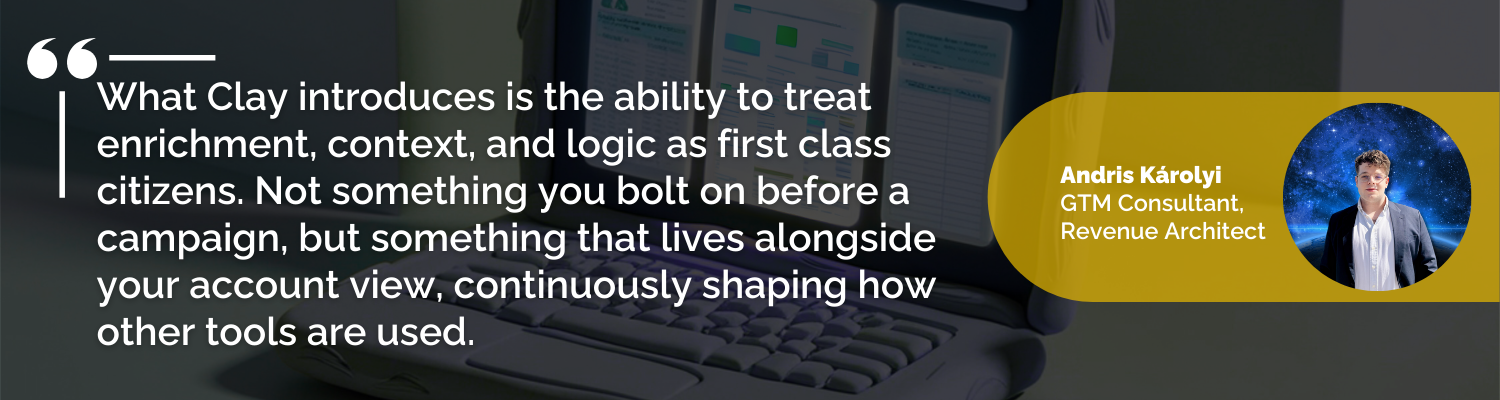
What Clay introduces is the ability to treat enrichment, context, and logic as first class citizens. Not something you bolt on before a campaign, but something that lives alongside your account view, continuously shaping how other tools are used.

In practice, this opens an unusual door. Instead of tools deciding behaviour through their default workflows, teams begin defining behaviour through shared logic.

This is less of a dramatic transformation, but more of a structural one.

From clever tools to composed systems

Consider what happens when Clay is allowed to sit upstream of execution.

A gifting platform no longer fires because a rep feels it might help, but because the system has recognized a pattern worth investing in. A personalized experience is not assembled ad hoc, but shaped by enrichment that already understands the account and the individual. Content adapts not because someone remembered to configure it, but because context was already present.

What emerges is not automation theatre, rather a form of composure.

The stack begins to behave less like a collection of clever parts and more like a single instrument. Each tool retains its strength, but none is forced to compensate for the absence of coordination.

In my opinion, that is the difference between owning tools and building a system.

Why this feels timely

There is a lot of noise right now about acceleration. Faster outreach, faster personalization, faster… everything. Speed is seductive, especially when technology makes it cheap.

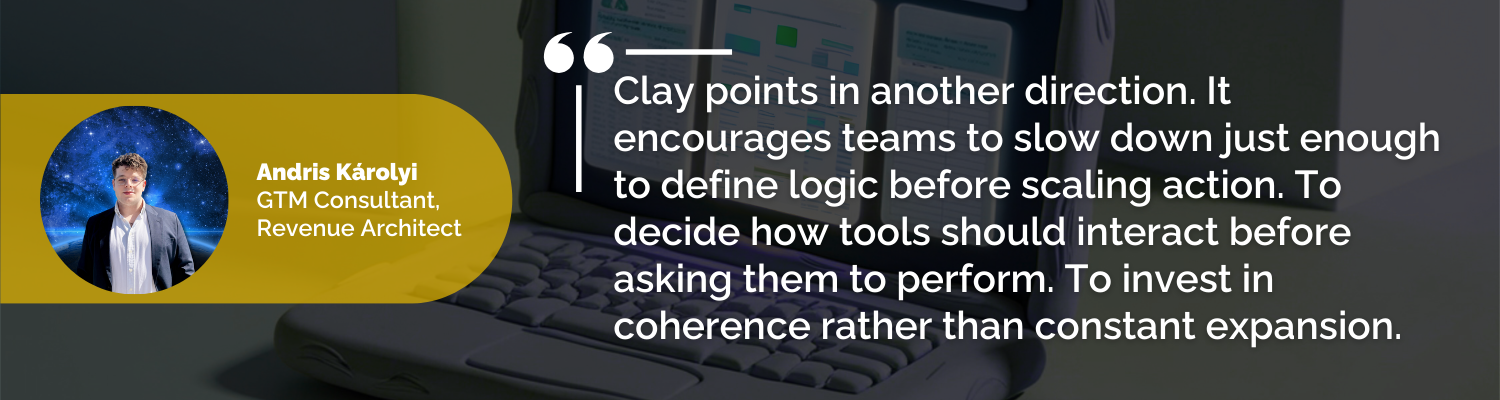
But experienced GTM teams probably know by now that speed without structure simply moves confusion around more quickly.

Blog Quote (1500 x 600 px) (1500 x 400 px) (11)

That posture is exactly what I find increasingly valuable.

Looking ahead

I do not see Clay as a finished story. I see it more as an enabling chapter.

There is room to explore how this kind of system thinking plays out across ABM programs, outbound motions, lifecycle experience, and expansion strategies. There is room for concrete examples, failures, and revisions. There is room for learning.

What is exciting is not that one tool can do more, but that a well-considered system can do less, more effectively.

That is the direction we are interested in at Infinityn. Clay fits into that direction not because it promises answers, but because it helps us ask better questions about how our GTM stack should behave as a whole.

And that, I think, is how durable systems are built.

Combining GTM theory with tools like Clay takes more thought than simply adding another platform, but it often leads to more coherent systems.

That perspective shapes how we work with teams at Infinityn, across both strategy and hands-on execution.

If you’re exploring similar ideas, feel free to reach out.


What ChatGPT Ads Mean for B2B Marketing and the Buyer Journey

What ChatGPT Ads Mean for B2B Marketing and the Buyer Journey

Discover how AI tools like ChatGPT are transforming B2B marketing by influencing buyer decisions early in the journey, emphasizing trust and clarity...

Read More
Moneyball: Changing The Game Before The World Is Ready

Moneyball: Changing The Game Before The World Is Ready

Discover how Moneyball's data-driven approach to baseball can transform modern GTM strategies, emphasizing the importance of analytics and leadership...

Read More
Beyond the Hype: The Real Way AI Is Driving GTM Performance

Beyond the Hype: The Real Way AI Is Driving GTM Performance

Discover how AI is transforming go-to-market strategies by revolutionizing marketing, sales, and support, driving business growth, and providing a...

Read More
Rethinking Go-to-Market Strategies: The Power of Personalization in 2025

Rethinking Go-to-Market Strategies: The Power of Personalization in 2025

Infinityn and Trendemon partner to drive growth, combining AB GTM expertise and AI-powered website optimization for smarter, faster customer...

Read More
GTMonday Monthly Recap: January Edition

GTMonday Monthly Recap: January Edition

Stay updated with January's GTM highlights: AI alignment, timeless GTM truths, quarterly planning insights, and scalable revenue motions for...

Read More
Infinityn International & GTM Partners Join Forces to Revolutionize Go-to-Market Strategies

Infinityn International & GTM Partners Join Forces to Revolutionize Go-to-Market Strategies

Infinityn and Trendemon partner to drive growth, combining AB GTM expertise and AI-powered website optimization for smarter, faster customer...

Read More
Infinityn and Trendemon Forge Strategic Partnership

Infinityn and Trendemon Forge Strategic Partnership

Infinityn and Trendemon partner to drive growth, combining AB GTM expertise and AI-powered website optimization for smarter, faster customer...

Read More
The Hidden ROI of LinkedIn Content: The mental availability

The Hidden ROI of LinkedIn Content: The mental availability

Unlock the hidden ROI of LinkedIn content by building mental availability and trust through consistent, meaningful engagement that drives long-term...

Read More
The New Playbook for AI-Powered Outbound

The New Playbook for AI-Powered Outbound

Discover how AI-powered outbound workflows can enhance your sales strategy by improving targeting, data quality, and personalization, while freeing...

Read More
How Modern Teams Turn CRM Enrichment Into a Competitive Advantage

How Modern Teams Turn CRM Enrichment Into a Competitive Advantage

Discover how continuous CRM enrichment transforms data into a competitive advantage, enhancing sales and marketing effectiveness for modern teams.

Read More
Your Page Just Got Personal: Infinityn X Userled

Your Page Just Got Personal: Infinityn X Userled

Discover the synergy between Infinityn and Userled, enhancing B2B marketing with personalized, precise engagement and strategic orchestration for...

Read More
The End of Fragmented GTM: Unifying Outbound and Inbound with Clay

The End of Fragmented GTM: Unifying Outbound and Inbound with Clay

Growth isn’t about more, it’s about precision. See how Infinityn and Clay turn strategy into a real-time, data-driven GTM engine.

Read More